
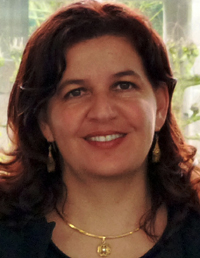
Victoria Lugo, Ph.D.
Universidad de Caldas
Carrera 24 No. 55-123 (Home)
Manizales, Caldas, Colombia
Phone: 57 6 8853276 (Home)
Email: victoria.lugo@ucaldas.edu.co
Victoria is Psychologist and Master in public health. She completed her
PhD at Taos Institute PhD program in 2014, under the supervision of Dr.
Sheila McNamee. Her dissertation “Disarmed warriors: narratives with
youth ex-combatants in Colombia” was honored Cum Laude. She is Professor
and researcher in the Faculty of Social Sciences at Universidad de
Caldas, Colombia.
For several years, Victoria worked in NGO´s with vulnerable populations,
especially youth, children and families in rural areas. She had been
involved in communitarian and research projects as Psychologist and
researcher, and she was the director of the research department at
Foundation for the integral development of childhood, youth and family –
FESCO, from 2004-2009. Her work was focused on social diagnosis,
evaluation and systematization of social intervention projects.
As a professor, Victoria began her teaching practice from 1997 in
Psychology Faculty at Universidad de Manizales, Colombia. Her main areas
of teaching were social and community Psychology, national context and
qualitative research. From 2009 until now, Victoria has been professor
at the Faculty of Social Sciences, Universidad de Caldas, in Manizales,
Colombia. Her main areas of interest now, are: social Psychology,
conflict, cohabitation, education, peace studies, communitarian
development, social constructionism and qualitative research. In both
universities, Victoria taught in undergraduate and graduate programs,
and also she was director of undergraduate and master thesis.
From 2009 until now, Victoria works as researcher at CEDAT (Centre for
conflict, violence and cohabitation studies). Her work is focused on
conflict and post-conflict transformation under social constructionist,
dialogue and narrative approaches. She is currently the editor of
Eleuthera, a social sciences journal edited by Universidad de Caldas.
Victoria Lugo, Ph.D. Manuscripts
- Nelvia Victoria Lugo Agudelo Dissertation
- El mundo afectivo de la adolescente embarazada
- Emergence and Evolution of Social Constructionist Ideas: A Conversation with Sheila McNamee
- Juventud, narrativa y conflicto: Una aproximación al estado del arte de su relación
- Narrativas del conflicto sociopolítico y cultural de jóvenes en seis contextos locales de Colombia
- Niñas, Niños Y Jóvenes Excombatientes: Revisión De Tema
- Saberes. Narrativas de Conflicto: Jóvenes del Kilómetro 41