
The Peer Mentoring Project: Kent State University
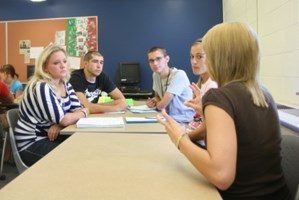
The Peer Mentoring Project at Kent State University is a program that was started as a way to support undergraduate teacher candidates in their required Educational Psychology course. Mentoring has been found to increase students’ academic success, social skills, self-efficacy, and ability to refine their professional dispositions. More importantly, mentoring serves to connect learners on a university campus; it diminishes the din of isolation while opening possibilities of connectedness in the world.

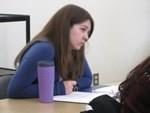
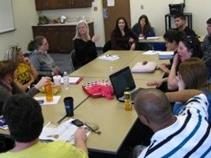
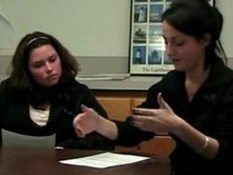
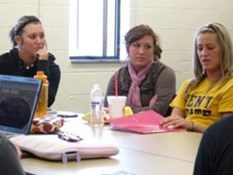
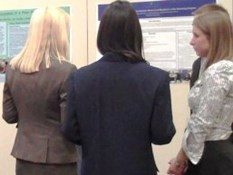
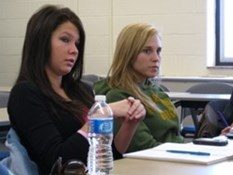
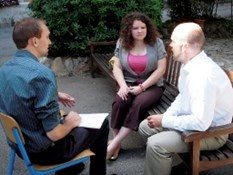
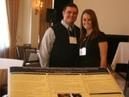
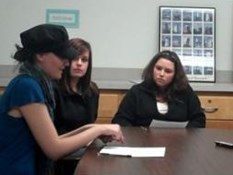
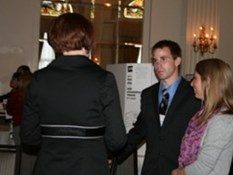

The Peer Mentoring Project began informally, with former students dropping by the classroom to say hello and staying for that day’s class. Over the past several semesters, it has grown and evolved into a formalized research project and a Relational Learning course, which students can take for University credit.
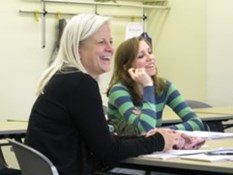
The mentoring project has served as a context that allows students and professors to engage in relational learning. Relational learning is a way of being with learners from a social constructionist perspective where students, mentors and professors learn from each other through the back and forth sharing of ideas and experiences. The project invites students and professors to enter into a dialogue about learning. At the same time, the involvement of the mentors deconstructs the hierarchy of the traditional teaching relationship and opens space for more collaborative experiences.
In this Project, mentors are students who have already successfully completed the undergraduate Educational Psychologycourse, and agree to come back during subsequent semesters to mentor the students enrolled in the current Educational Psychology course. When the Project began, mentors participated on a volunteer basis. As the Project evolved, the for-credit course Relational Learning in Education was developed; the only elective course in our teacher education program. Students wishing to mentor the incoming Educational Psychology classes enroll in Relational Learning in Education, meet regularly, and engage in outside projects related to mentoring, the field of education, and relational learning. Relational Learning in Education has been opened to students across campus from all disciplines.
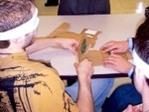
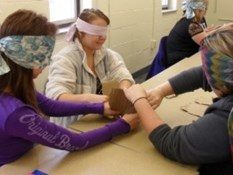
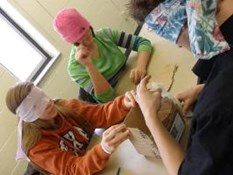
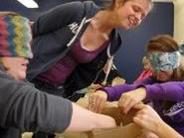
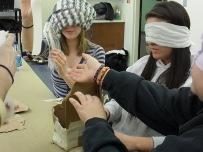
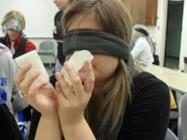
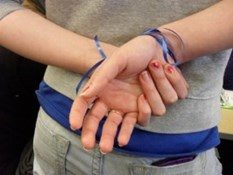
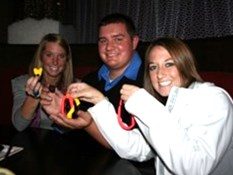
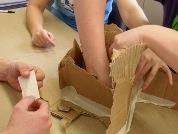
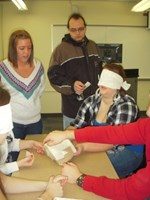
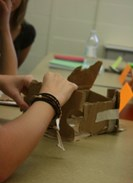
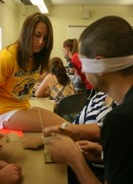
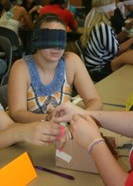
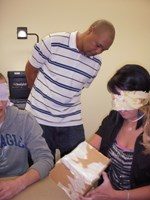
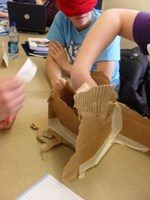
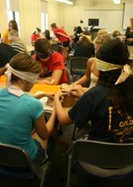
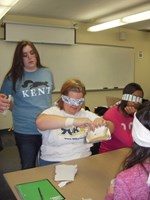
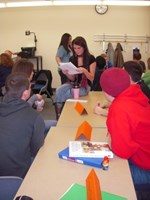
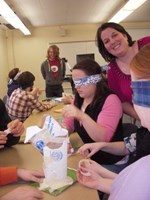
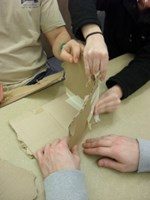
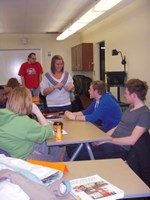
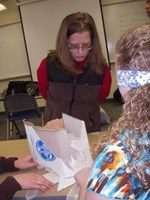
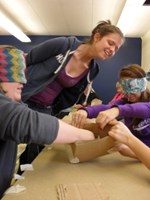
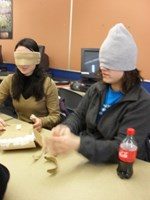
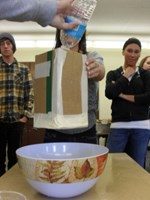
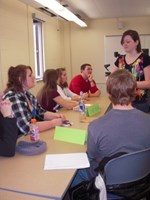
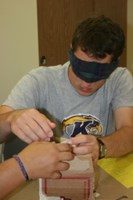
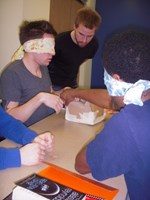
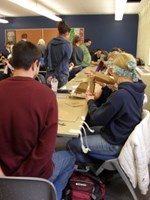
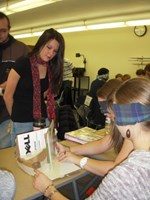
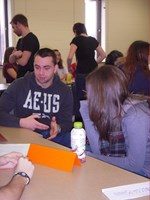
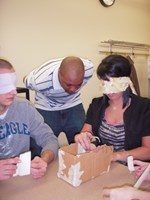
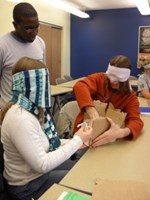
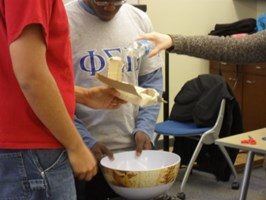
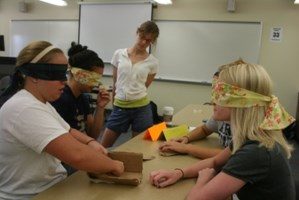
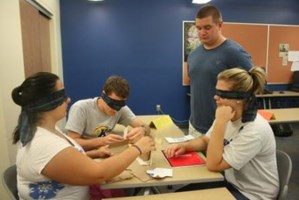
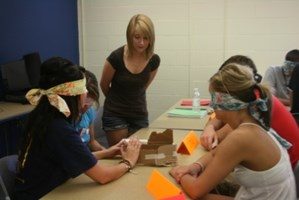
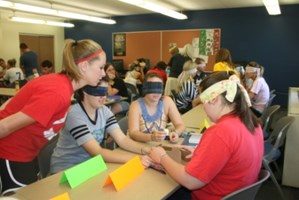
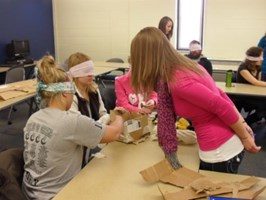
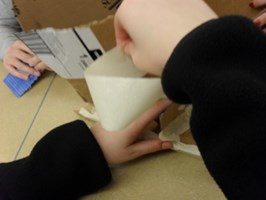
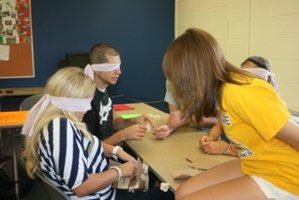
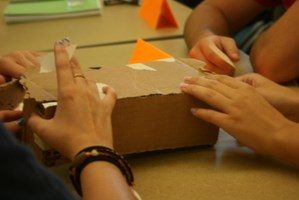
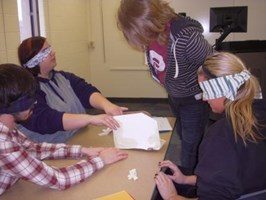
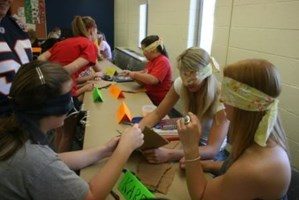
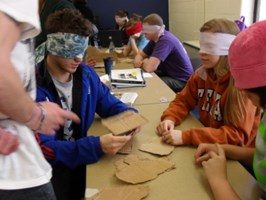
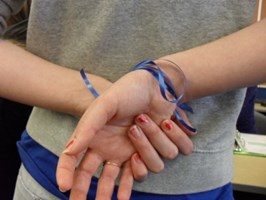
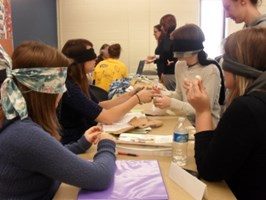
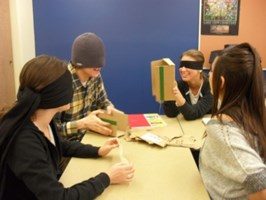
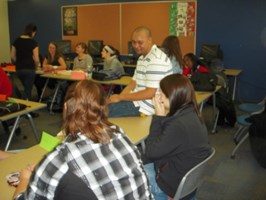
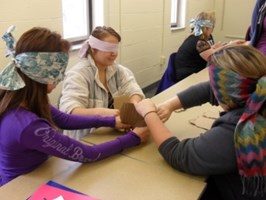
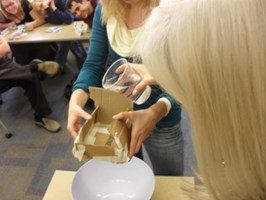
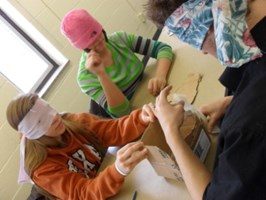
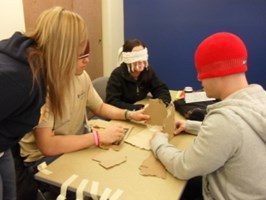
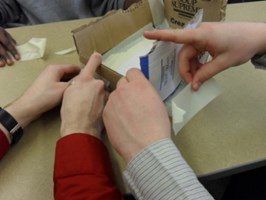
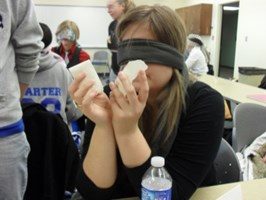
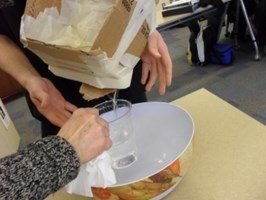
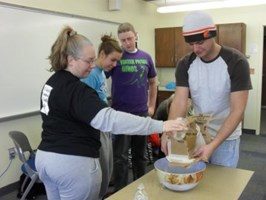
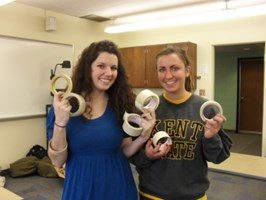
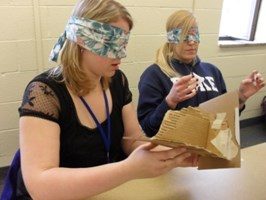
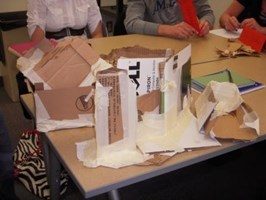
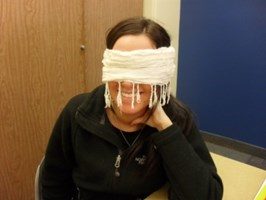
Early in the semester, mentors arrive in the Educational Psychology class to engage in a shared “ice-breaker” activity, called Plane Wreck (see the photo gallery, below, for more on the Plane Wreck). Both the students and the mentors (and those of us who watch, take pictures, and hand out tape) enjoy this activity, which incorporates fun, listening, giving instructions, teamwork, a little friendly competition, and some trust.
The Peer Mentoring Project has expanded, forming partnerships with local schools and programs as a way for the Mentors to observe, learn, and experience the larger community through the lens of relational learning. One project the mentors can choose is Conversation Partners, a University-sponsored program which pairs domestic and international students to meet informally for conversation. A second project allows mentors to partner with teachers and students in a local inner-city elementary school and experience first-hand some of the struggles and rewards that come with a challenging environment. A third option reaches into the international community to establish mentoring relationships with students and teachers from an international school in Italy.
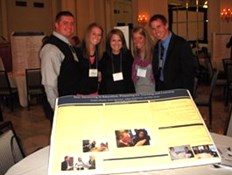
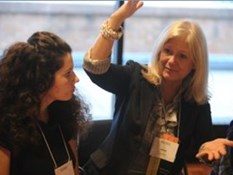
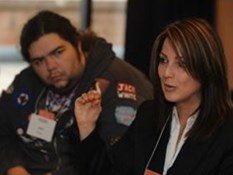
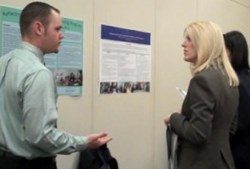
Mentors have engaged in a number of professional development opportunities, including local and regional conference presentations, leading campus-wide discussions on mentoring, and serving as mentors for the Educational Psychology in Italy course (below).
Plane Wreck!
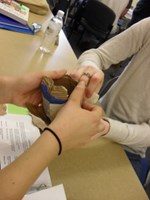
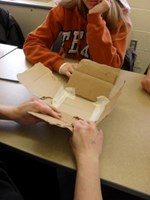
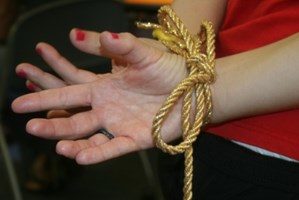
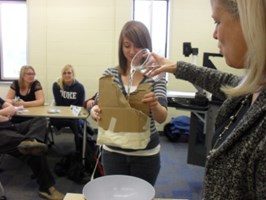
The premise of the Plane Wreck activity is that we were all on our way somewhere, when our plane went down. Everyone survives; we just need to wait for help. Until then, we will need water to survive; however, some of us (the mentors) have lost the use of their hands (which are tied behind their backs), while others (the mentees/new students) have lost their sight (and are blindfolded). Working together in small groups (1 mentor, 2-3 students), they must construct a water-tight container using only what is available: a few pieces of cardboard and some masking tape.
What Students Have to Say About the Peer Mentoring Project:
“Being on this [mentor] side I had to think back, saying, ‘this is exactly what I was doing and I need to be the person to help guide them just the same way I was guided.’ They don’t know exactly what they’re doing, just like I didn’t know what I was doing last year.”
“The relationship is personal yet professional. Mentoring creates space for the teacher candidates to take on multiple perspectives within their role.”
“I’ve gained valuable experience for my future of being a teacher because I feel like, the more I work with students, the more I work with peers, the more I work with professionals in the field, the better experience and more knowledge I’m going to have as a first year teacher in the next year, year and a half, and I feel like that experience right there is more valuable than any experience I could have sitting in a class, reading a text book.”
“It’s been a learning experience for me. I take everything that I do as a learning experience because, as a future teacher, the more I work with students, the more I work with professors, adults, professionals, then the more experience I’ll get and more I’ll learn about what it is, exactly, to be a teacher. So I’ve taken this experience as kind of both a learning experience and an experience to kind of further my skills as a teacher.”
The Peer Mentoring Project in the News:
Conference Presentations:
Below you will find some of our presentation material that we have taken to local, regional, and national/international conferences.
Please feel free to browse through the posters, papers, symposia, workshops, and roundtable discussions that we have shared at conferences over the past several semesters.
- Reflecting Processes (Poster) (564.38 KB)
- Collaboration and Interaction (Poster)(590 KB)
- Involving Students in Their Education (Roundtable) (87.52 KB)
- Intrapersonal Outcomes in Peer Mentoring (Poster) (860.13 KB)
- Learning to Listen: Reflecting Processes (Workshop) (18.26 MB)
- Mentoring: Preparing for Teaching/Learning (Poster) (601.35 KB)
- Reflecting Processes in Research (Poster)(892.26 KB)
- Relational Learning: Peer Mentoring (Workshop) (135.74 KB)

Suggested Readings:
- Relational Being: Beyond Self and Community by Kenneth J. Gergen (July 30, 2009)
- The Reflecting Team: Dialogues and Dialogues About the Dialogues edited by Tom Andersen (10-17-1991)
- The Reflecting Team in Action: Collaborative Practice in Family Therapy edited by Steven Friedman
- Participant Observation by James P. Spradley (January 2, 1980)
- Designing Qualitative Research by Catherine Marshall and Gretchen B. Rossman (Apr 13, 2010)
- Basics of Qualitative Research: Techniques and Procedures for Developing Grounded Theory by Corbin
Meet the Taos Associates Responsible for this Project:
Anne Morrison, Ph.D.

During an undergraduate double major in psychology and sociology I discovered a desire to grow old on a college campus. After many years and careers this desire brought me to Kent State University where I earned a Masters in Community Counseling and a Ph.D. in Counseling and Human Development. I began teaching Educational Psychology while working on my doctoral degree and realized that relational learning was grounding me in the university setting. I became interested in the social construction of knowledge where the learning-teaching relationship is egalitarian in nature. This collaborative approach to teaching and learning creates space where knowledge expands in the back and forth conversation of everyday experience. An interest in international study has taken me to Cuba, Norway, Russia, Ireland, Italy, Sweden, and Finland. I especially appreciate working with students on international study abroad. Recently, I created a new Relational Learning in Education course, in it, students choose from several engaged learning options, including becoming peer mentors for students enrolled in my Educational Psychology classes, serving as mentors in a local inner-city elementary school, and participating as supports to the growing international student population on the KSU campus.
Kristen Chorba

I am an instructional designer at Kent State University (Ohio). As an instructional designer, I work with faculty to develop and enhance online courses for the College of Communication and Information. My work allows me to collaborate with a wide variety of faculty who are engaged and invested in what they do. Together, we work to make the courses they teach even better, through collaboration, technology, and educational psychology principles. I love the challenge of helping to find solutions for complex online teaching and learning approaches and helping faculty and students have great online learning experiences.
I earned my Ph.D. in December, 2013 from Kent State University. My dissertation focused on a peer mentoring project that I have been collaborating with Anne Morrison on, for the past six years. In this project, we have been exploring peer mentoring and relational learning among undergraduate teacher education majors. The project is led by Anne. My dissertation (Relational Learning: A Study of Peer Mentoring Experiences among Undergraduate Teacher Education Majors) focuses on this mentoring project and incorporates reflecting processes, photo elicitation, and phenomenological interviewing to describe the experiences of these mentors and aims to continue the conversation regarding what it is to be a mentor. Anne and I have presented locally and nationally about relational learning and peer mentoring, focusing specifically on the outcomes and insights gathered through our research on this mentoring project.
My research interests include teacher education, mentoring, relational learning, and online education. I have also worked with the Taos Institute to highlight projects and/or research by Associates who engage in relational practices in education and am currently collaborating on other projects that are underway, including Taos group spaces.